Your Agent Has One API Key and Fifty Bosses
Here is how a lot of company agents work today. Fifty people talk to one bot in Slack. Each of them signed in as themselves. The bot then calls the CRM, the billing system and GitHub with a single API key that somebody pasted into an environment variable in March. Whatever that key can do, the bot can do, for anyone who asks nicely.
Nobody designed it that way. It is just what you get when you wire an agent to tools in an afternoon, and it is one of the first things a security review flags.
This issue is about one question: how does an agent act for one specific person without holding everyone’s keys? Four teams answer it. Two put a proxy in front of every request, one issues short lived credentials per request, and one runs the action itself so the agent never touches the API at all. Those are real architectural differences, and they matter more than the feature lists.
Alter
A proxy that holds the credentials and decides, call by call, what the agent may do for this user.
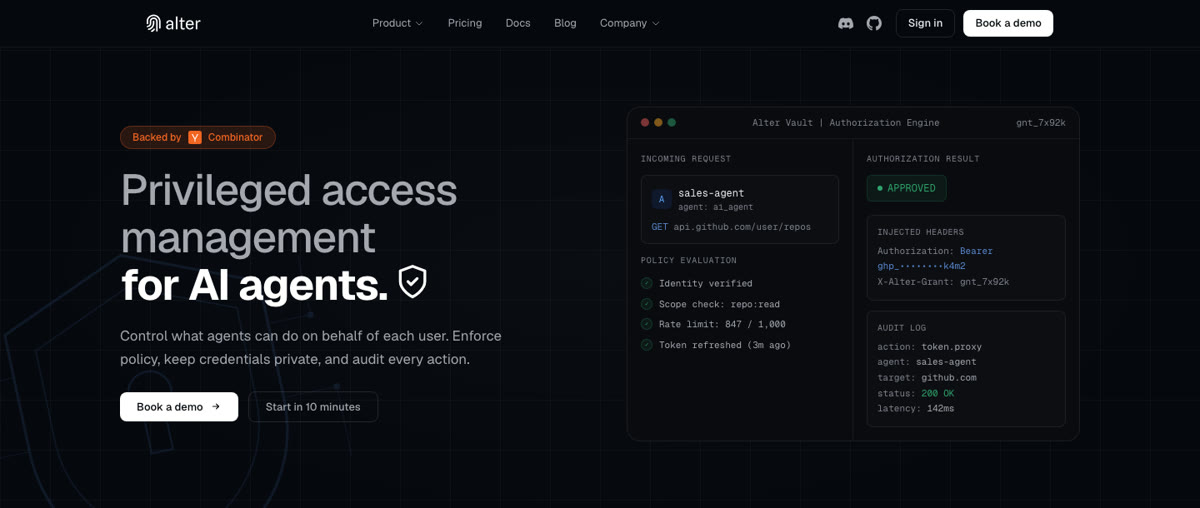
Srikar Dandamuraju led platform engineering at Goldman Sachs after stints at Addepar and Clear Street. The launch post describes how expensive it was there to write custom auth so agents could serve many users under strict policy. Cofounder Kevan Dodhia was technical cofounder of Compute.ai, which was acquired in 2025. The company is in New York, from YC’s Summer 2025 batch.
The mechanics, from their platform page: your code makes one call. Alter works out who the agent is acting for, checks policy, pulls the right OAuth token or API key out of its vault, attaches it to the outgoing request, forwards it and writes an audit record. Tokens are encrypted at rest and refreshed before they expire. Policy is default deny and goes down to individual parameters: scopes, endpoints, time windows, rate limits and content rules. Each agent gets its own identity with a delegation chain back to a real person, and sensitive calls can pause until someone you name approves them, then run exactly as approved.
The piece I would point at is the Wallet: a page where an end user sees every connection an agent made on their behalf and can revoke any of them in one click. Most products in this space are built for the security team. That one is for the person whose account is being used, and I think it is underrated.
It speaks OAuth 2.0, OIDC and AWS SigV4, sits behind Okta, Auth0, WorkOS or Clerk, and ships Python and TypeScript SDKs plus an MCP server your coding agent can use to wire it in. Pricing is per call, not per seat: free up to 10,000 calls a month, then $50 for 100,000 and $0.50 per extra thousand. SOC 2 is listed as in progress.
The launch thread found the hard cases fast. If the agent reads a deal record under the CEO’s access and posts a summary to a shared channel, a contractor can read it later; the permission check happened, the data still leaked. And when my agent hands part of a job to your agent, whose permissions apply? Neither is an Alter bug. Both are where this whole category is still thin.
OneCLI
An open source platform that gives every employee their own agent in a sandbox whose only way out is a credential injecting gateway.
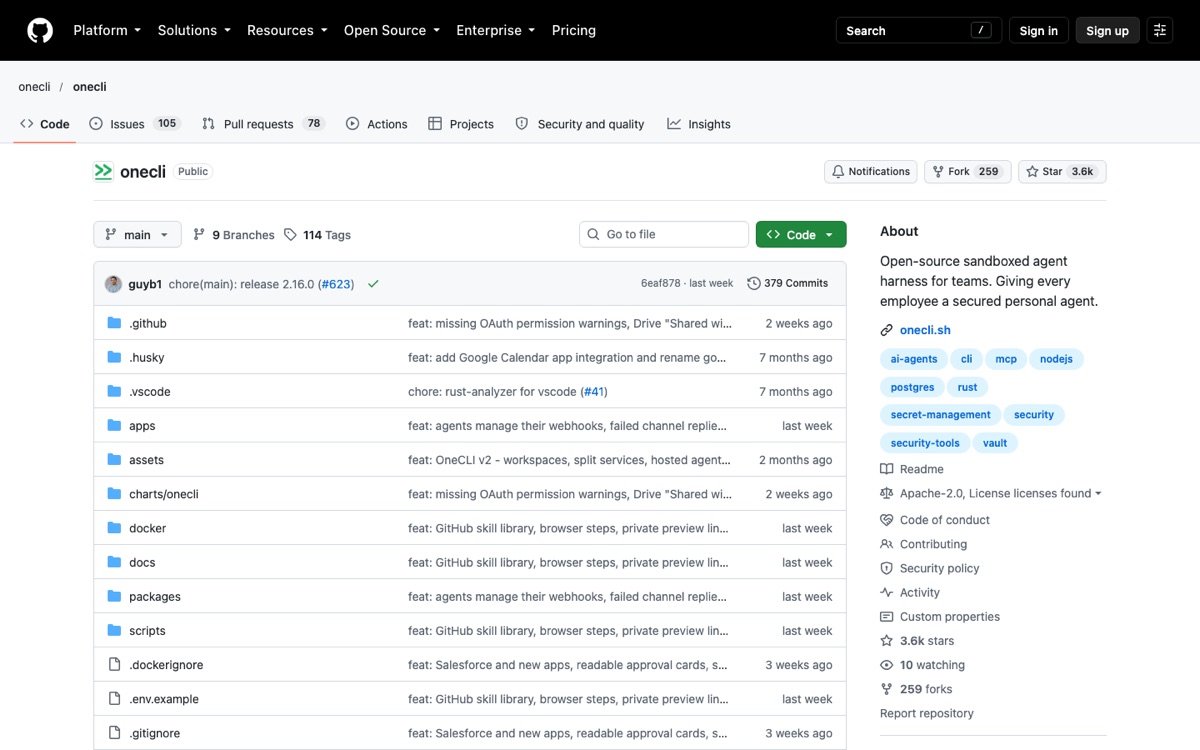
Jonathan and Guy spent their careers in security and were building ChartDB, an open source database tool, when they started running agents on top of it in January. They describe the problem bluntly in the launch post: agents keep credentials in memory, write them into local files and session logs in plain text, and can be talked into handing them over. OneCLI started as a credential vault written in Rust and grew into something larger.
The answer here is architectural rather than a policy layer. According to the README, each person gets an agent provisioned from the company identity provider, and each agent lives in its own sandbox with a filesystem and a shell. The sandbox’s only network exit is a Rust gateway that intercepts outbound requests, HTTPS included, and injects the credential at that point. The agent authenticates to the gateway with its own access token in a Proxy-Authorization header and never sees the real key. Secrets are stored with AES-256-GCM, decrypted only at request time and matched to requests by host and path pattern. If you would rather not store them at all, it can pull them on demand from 1Password or Bitwarden.
Intercepting HTTPS means the sandbox trusts the gateway as a man in the middle. That is the price of injecting into encrypted traffic, and it is fine inside a sandbox you control, but it is worth knowing before you route anything sensitive through it.
Approvals are deterministic: sending an email, deleting a Linear ticket or emptying an S3 bucket can be set to always stop for a human, by rule rather than by another model’s judgment. Team level connections, like a shared model key or a service account, are granted to agents without being handed to them. The runner that hosts sandboxes only makes outbound connections, so it can run on a laptop or inside a VPC with no inbound ports.
You can self host the whole thing (Apache 2.0, about 3,600 stars since March, Helm chart included). The hosted version is priced per seat rather than per call: free for 3 people and 500 integration calls a month, then $149 a month for 5 people and 10 agents if you bring your own model key.
The best objection in the thread was the confused deputy. An agent allowed to call your CRM can still be persuaded to export the CRM through a perfectly allowed call. Hiding the key does not stop that. Of the four, this is the one where you can read the code and check exactly what happens to your secrets, and for this category that is worth a lot.
Keycard
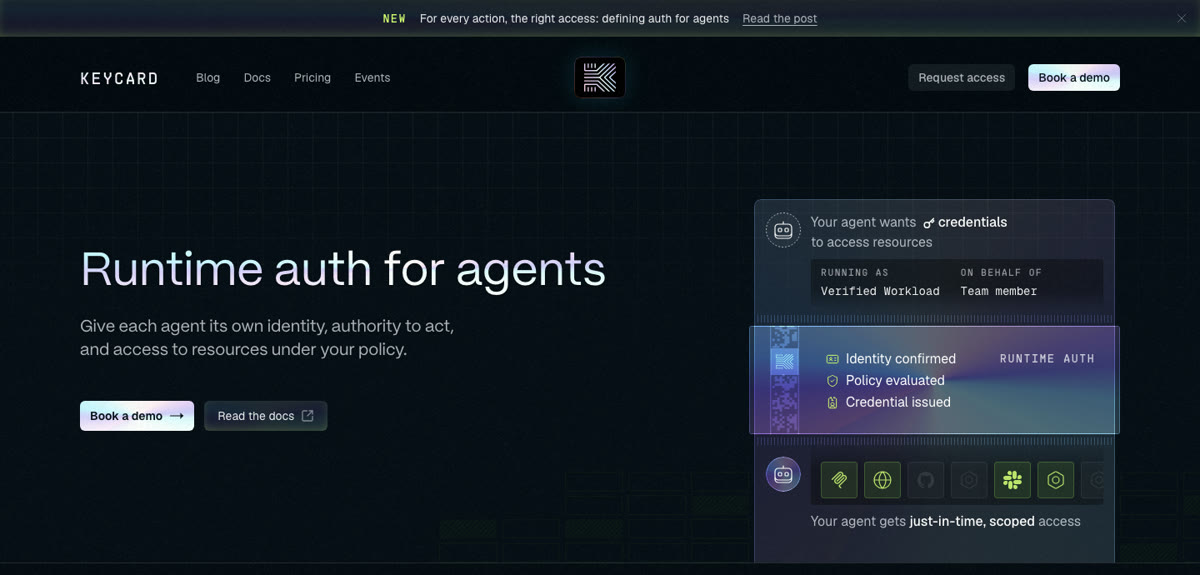
Identity infrastructure for agents from people who built identity infrastructure for everyone else.
The founding team is the reason to pay attention. Jared Hanson created Passport.js, the long running authentication middleware for Node. Ian Livingstone is CEO and Matthew Creager runs product. Their about page lists $38M raised, with individual investors that read like an identity conference speaker list: Auth0’s CTO, Okta’s chief product architect, Cloudflare’s CTO, Datadog’s CISO and Anthropic’s head of security engineering.
As its homepage describes the flow, Keycard does not sit in the data path the way Alter and OneCLI do: the agent asks for access, Keycard verifies which agent it is and where it is running, attaches the identity of the user it is acting for and what it is trying to do, evaluates policy, and issues a credential scoped to that request, just in time. Resources such as MCP servers, internal APIs, data stores or other agents are connected once with their credential provider, and Keycard answers every authorization request against them. Policies can be role based, attribute based or relationship based.
If that reading is right, the design trades differently. The agent does hold a credential, but a narrow one that expires quickly, and nothing has to proxy your traffic. For a company with many agents and MCP servers and an identity team that already thinks in policies, that is probably the more natural fit.
The one customer quote on the site is from a product manager at Chime: “We had agents running against production systems in days.” The pricing counts transactions, meaning every time Keycard issues, validates or exchanges a credential. There is a free tier capped at 5,000 a month, then $500 a month for 100,000 and $1 per extra thousand. That jump from free to $500 is the clearest signal of who it is for, and it is not a five person startup.
Arcade
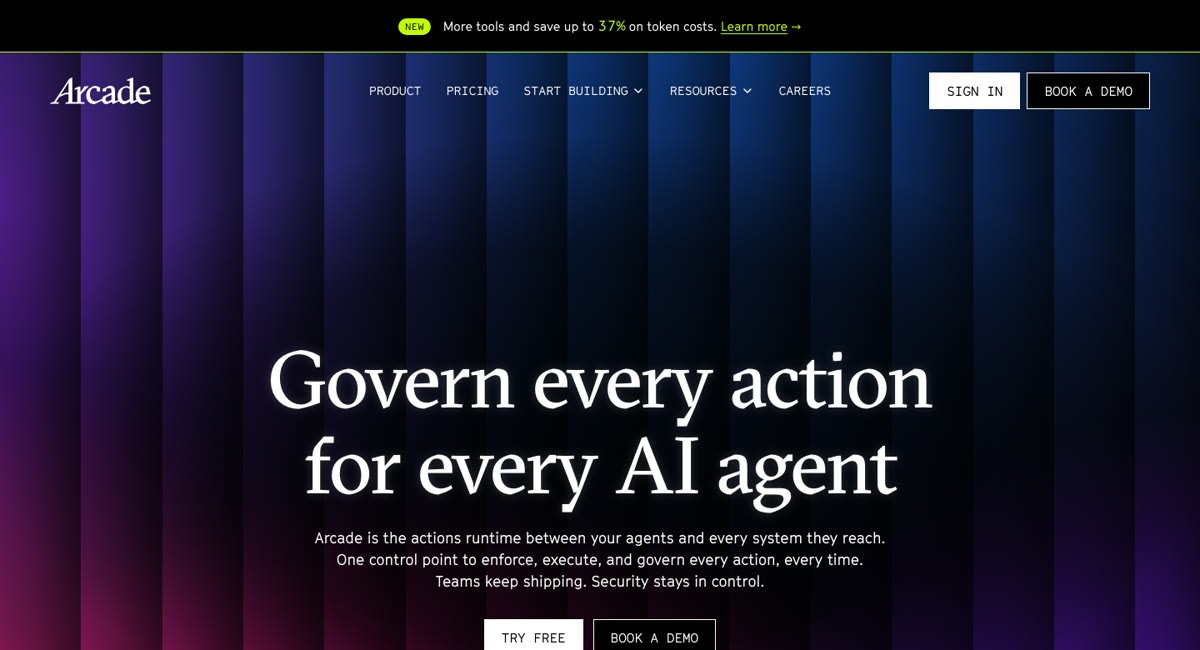
Instead of guarding the agent's API calls, it makes them, so the agent never touches a raw API or a token.
Alex Salazar, the CEO, has been close to this problem for a long time: VP of product management and later a general manager at Okta, and before that cofounder and CEO of Stormpath, which Arcade’s about page calls the first authentication API for developers. Sam Partee, the CTO, was a principal AI engineer at Redis and led the team behind its vector database work.
Arcade calls itself an actions runtime. The agent asks Arcade to do something, say create a ticket or send a message, and Arcade authorizes it against the intersection of what that user can do and what this agent is allowed to do, runs it with the user’s own OAuth token, and logs it. According to the product page, it handles the OAuth dance, refreshes and rotates tokens, and injects credentials at execution time, so neither the agent nor the MCP client ever sees them. Hooks before and after each tool call enforce your policy. It runs in their cloud, in your VPC or fully air gapped.
The other half of the pitch is the tools themselves. Their argument is that an API wrapper is not an agent tool, and that the gap between what a user means and what an API expects is where agents hallucinate and retry. So Arcade maintains the tools too. Whether you want that depends on whether you would rather own your integrations or rent them.
Pricing splits the two jobs: $25 a month plus $0.10 per auth event, when an agent is connected to a user’s account, and $0.01 per tool call, with 2,000 of each free every month. Per call that looks expensive next to Alter’s $0.50 per thousand, but it is not the same product. Alter forwards your request; Arcade also runs and maintains the tool.
Side by Side
| Approach | Where the credential lives | Paid entry | |
|---|---|---|---|
| Alter | Proxy on every call | Alter’s vault, attached on the way out | $50 a month, 100K calls |
| OneCLI | Sandbox with a gateway as the only exit | Gateway or your password manager | Self host free, or $149 a month for 5 people |
| Keycard | Issues a scoped credential per request | Short lived, held by the agent | $500 a month, 100K transactions |
| Arcade | Runs the action itself | Arcade’s runtime | $25 a month plus usage |
How I Would Choose
- One shared agent in Slack, a small team, and a security review coming: Alter. It is the cheapest way to stop using one key for everyone, and the Wallet gives your users something to point at.
- An agent for every employee, and you want to see the code: OneCLI.
- Dozens of agents and MCP servers, and an identity team that already owns policy: Keycard.
- You would rather not build or maintain integrations at all: Arcade.
What none of them solves is an agent that misuses access it legitimately has, because something it read told it to. Every one of these products narrows what the agent may do for this user. None can tell whether this user would actually want it done. That is still open, and I suspect it is the next round of launches.