LiteLLM Fell Twice. Who Holds Your Keys Now?
An LLM gateway is the one process in your stack that holds the keys to every model provider at once, which makes it the worst place for a bad release. I would rather run a small compiled gateway that I pin myself than keep trusting a release pipeline that has now failed twice. On October 21 it failed for the second time this year. Version 1.107.0 reached PyPI and Docker carrying a credential stealer. It sat on PyPI for 1 hour 44 minutes, and Docker images tagged latest served it for about two and a half hours. LiteLLM says the attacker worked through the GitHub accounts of three of its own engineers. The March incident, two poisoned versions live for about 40 minutes, came from a compromised scanner in its CI.
The fair objection is to stay on LiteLLM and pin it. The safe version, 1.106.2, is known, and LiteLLM said in March that its official Proxy Docker image, which pins its dependencies, was not affected. If you already run it that way, pinning by hash is a defensible answer for now, and I would not rip it out on a Saturday. But both incidents were attacks on the release pipeline, and LiteLLM’s own March fix, a rebuilt CI pipeline, had been in place since March 30. Pinning only postpones the trust decision to your next upgrade, and that decision then rests on a pipeline that failed again after its rebuild. The three newcomers below have much shorter records, so they get the same treatment: pinned, built from source where possible, and given limited keys.
So the question for this issue is which open source gateway should hold your model API keys now that LiteLLM has been compromised twice? I have not run any of the three below. Everything comes from READMEs, docs, pricing pages, one launch thread and the vendors’ own benchmark tables, which I treat as marketing.
Respan Gateway
A Rust binary where every feature is a plugin you compile in, from a company that was already leaving LiteLLM before either breach.
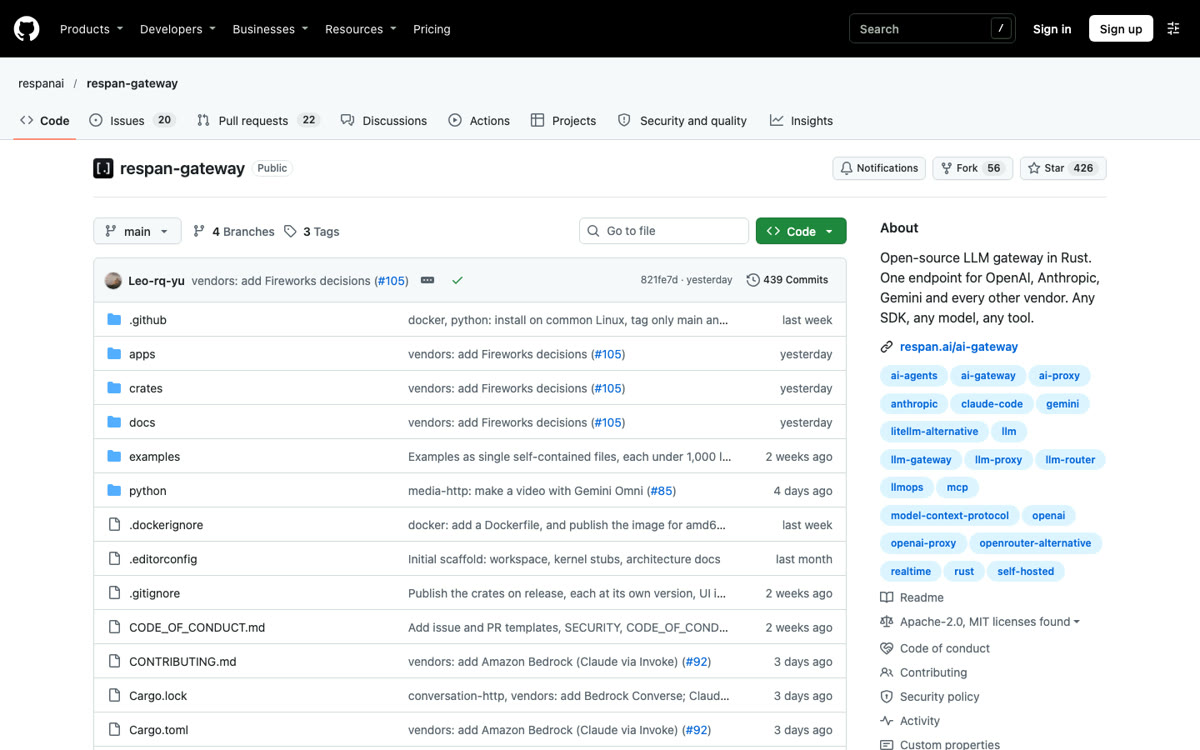
Respan was Keywords AI until a rebrand this spring. It came out of Y Combinator’s W24 batch and reportedly raised a $5 million seed led by Gradient Ventures. CEO Andy Li said in an interview that the job before the company was product design engineer on AirPods 4 at Apple, and that school was left behind to build full time. In the Launch HN post, Li explains the gateway’s origin plainly. Respan had wrapped LiteLLM since 2024 until the wrapper passed 100,000 lines, a routine upgrade in January caused connection errors nobody could explain, and they stopped upgrading directly. That is a maintainability story, and it predates both breaches.
The design is small core, everything else a plugin: providers, protocols, fallbacks, PII masking. The repository was created on September 25 and has 426 stars, 56 forks and an Apache 2.0 license. With no config file, every vendor whose key is in your environment becomes a provider, and a plain chat call can use MCP tools configured in the gateway. Listening beyond localhost requires a client key. The self published table claims 0.07 ms of added latency and 31 MB of memory.
The money comes from a hosted platform with tracing and billing. Its pricing page returned a rate limit error on both tries, so I cannot tell you what it costs.
The thread’s best exchange was about the word plugin. Commenter verdverm wrote: “Generally, when we use the term “plugin” in industry, this means we do not have to run a compiler.” Li’s answer was that plugins are crates compiled into the binary, and custom logic needs a rebuild. The same commenter pointed at authentication code that looks machine written and asked whether anyone had read it. Fair on both counts. Compile time plugins are the safer design for a key holder, but only for a team that reads Rust. Li said the team had pulled its own Docker image before launch because some APIs might still change, so you had to build it yourself; the README now shows a Docker command. The post calls the project pre alpha.
My verdict: the most interesting design here and the least ready. Watch it, and revisit when it has a tagged release history and an answer to the auth question.
GoModel
A Go gateway with the providers built in, aimed squarely at LiteLLM's users, run by a company whose only product it is.
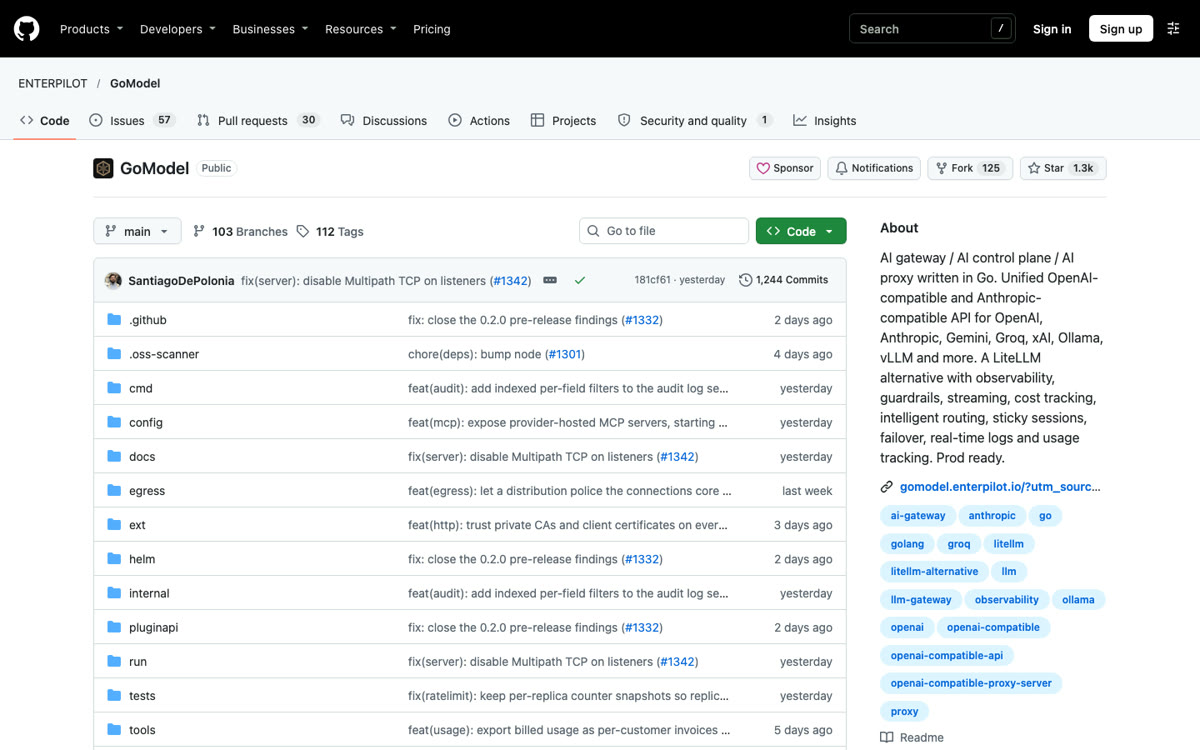
GoModel is made by enterpilot, Inc., which describes it as its only product. Jakub A. Wąsek is listed as the founder and primary maintainer, and I found no verified prior roles. The repository is MIT licensed, was created in December 2025 and has 1,293 stars and 125 forks. It was pushed to the day I looked, with 67 open issues. The site lists 37 providers and the version as 0.2.1.
It gives you an OpenAI compatible and an Anthropic compatible endpoint, plus aliases such as smart-chat that you can remap without touching application code, failover chains, per key budgets and audit logs that record the resolved route and each provider attempt. It runs as one binary with SQLite, Postgres or MongoDB behind it.
The catch is on the license page. The docs list prompt compression, OIDC SSO and intelligent routing as Pro features, with no price or unit anywhere I looked, and the page says openly that large clouds reselling open source infrastructure is a worry. On Hacker News the founder wrote “I would love to keep it open source forever, but I can’t promise that for now”. I respect the candor and discount the promise. Enterpilot’s own benchmark post is also upfront that it is “not comparing full product maturity here”, which is the right caveat for a table where GoModel wins every row.
The README opens by calling LiteLLM “hacked recently” and Portkey unmaintained. That is a sales line, but it is also true enough about LiteLLM. The first install line is a curl | sh script, and Docker and build from source are documented too. Take the build, because a script piped into a shell is a floating install nobody reads.
My verdict: the one I would put in front of a side project this week. Not for a company that needs SSO without a license conversation first.
Bifrost
The big one: more than seven times the stars of GoModel, a company behind it and an Enterprise tier that sets the price of the free one.
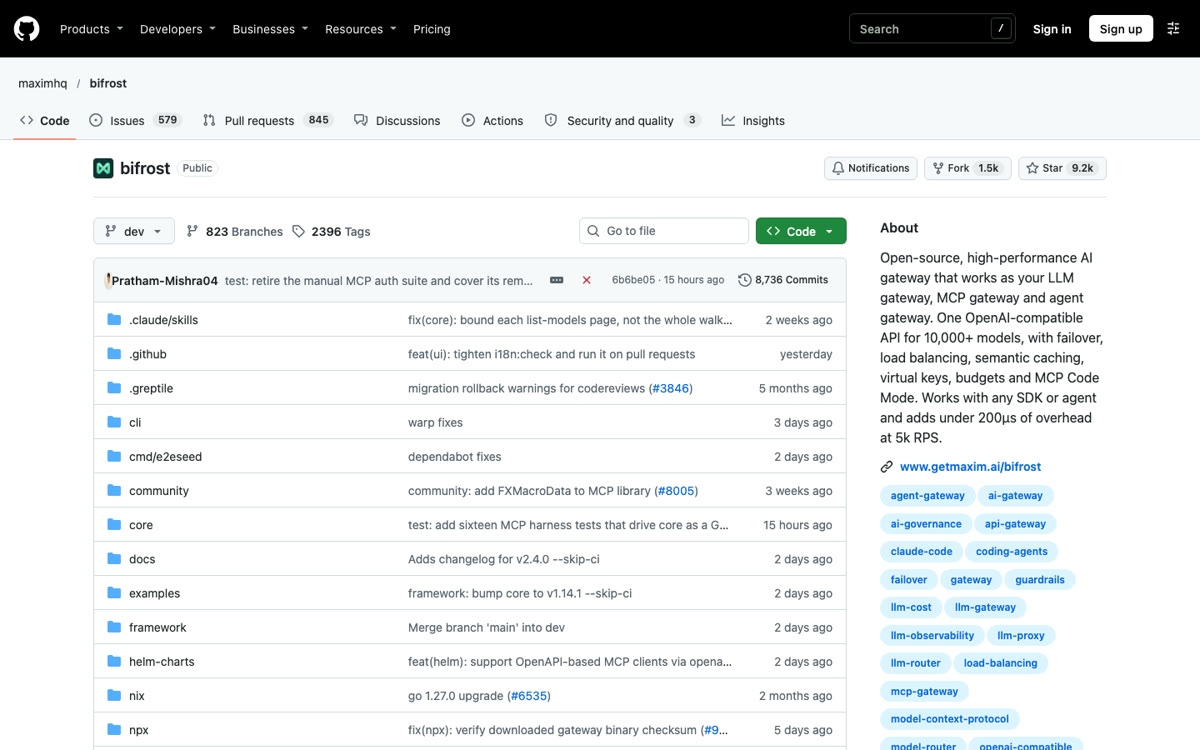
Bifrost belongs to Maxim AI, which Elevation Capital’s portfolio page says was founded in 2023 by Vaibhavi Gangwar and Akshay Deo, formerly of Google and Postman. The same page lists a $3 million seed round led by Elevation. The repository has 9,242 stars, 1,494 forks and an Apache 2.0 license, and was created in March 2025. It lists 23 providers, failover, load balancing, semantic caching, virtual keys, budgets and an MCP gateway, with a claimed overhead under 200 microseconds at 5,000 requests per second.
The pricing page is where the free version shows its edges. Virtual keys and budgets are free. Vault support, SAML and OIDC single sign on, role based access, audit logs, guardrails and cluster mode are Enterprise, with custom pricing, which is a contact form where a price should be. Vault support is the line I care about. A gateway that holds every provider key, whose secrets integration costs extra, has told you where its money comes from. The setup docs say keys added through the web interface live in a SQLite file, config.db, in the app directory, next to a section on protecting the dashboard. I found no statement that the file is encrypted. GoModel’s docs at least list encryption at rest and secret references in their navigation. Until Maxim says otherwise, treat that directory as a vault with no lock.
You install it with npx -y @maximhq/bifrost or a Docker image. The first is the floating install pattern that bites in every ecosystem. Pin the image digest.
The scale is real, and it is the only pick where a stranger has probably hit your bug first. The benchmarks are the same story as everywhere. Maxim’s number is its own, Respan’s table has Bifrost at 0.16 ms and 488 MB, and every harness I found was run by a vendor.
My verdict: the default for a team shipping this quarter that can pay for Enterprise if it must. If you want the free tier alone in production, mount that directory on an encrypted volume and keep it off shared hosts.
Side by Side
| Respan Gateway | GoModel | Bifrost | |
|---|---|---|---|
| Language | Rust | Go | Go |
| License | Apache 2.0 | MIT | Apache 2.0 |
| Repository age | Created Sept 2026 | Created Dec 2025 | Created Mar 2025 |
| Stars | 426 | 1,293 | 9,242 |
| Where the money is | Hosted platform | Pro tier | Enterprise tier |
| How you install | pip, cargo, release binary, Docker | Docker, script, source | npx, Docker |
How I Would Choose
If you are a company that needs a gateway in production this quarter, I would take Bifrost, pin the digest, and budget for Enterprise the day someone asks for audit logs. If you are a person or a small team wiring up a side project, GoModel, built from source, because it is the simplest thing that replaces LiteLLM today. If you read Rust and like the idea of auditing your own gateway, watch Respan, but wait.
Two cases sit outside all three. Teams with export controlled data should read Consus, a hosted gateway that verifies every customer under contract and starts at $40 per seat a month, because no self run binary solves that problem. And nothing here fixes the part that made October hurt: one process, every key. Whichever gateway you choose, give it its own provider keys with spend limits, and treat a rotation as routine rather than an emergency.