Agents Fail Without Errors. Who Reads the Logs?
I would rather have a record a person can search than a second model to read it for me, and Laminar, below, talked me out of half of that. The agent failures that cost the most time raise no error. The agent cites the wrong document, or reports a step as done that it skipped, and every call finishes cleanly. A stack trace has nothing to show you.
When an AI agent fails without raising an error, how do you find out what actually happened? I have not run any of the three. Everything here comes from repositories, docs, pricing pages, launch threads and the vendors’ own benchmark tables, and I treat the last of those as marketing.
Laminar
Open source observability for production agents, plus a small model trained to read every trace so no human has to.
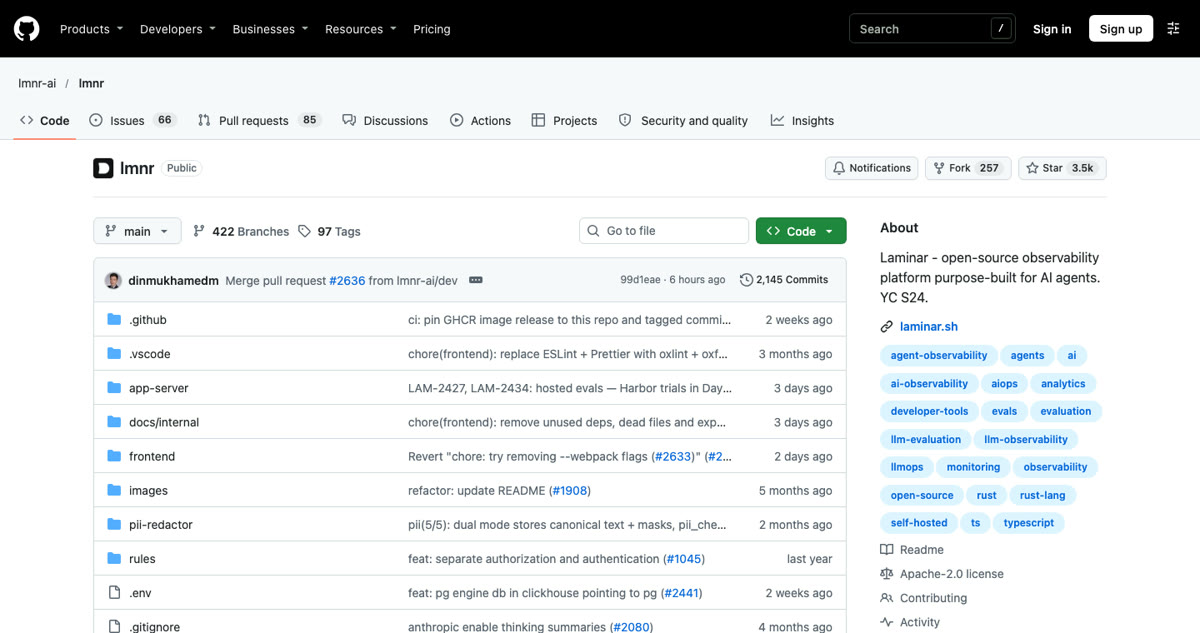
Laminar is a Y Combinator S24 company. Its Launch HN post is signed Robert and Din, and the company blog credits Robert Kim and Dinmukhamed Mailibay. I did not verify their earlier jobs. The blog index lists a March post about a $3 million raise; I saw only the headline. The repository was created in August 2024 and is Apache 2.0. Its latest release, v0.3.3, went out on November 2, the day I looked, from Din’s account.
It records LLM calls, tool calls and sub agents as traces. Its analysis feature, Signals, uses a model that treats each trace like a repository, with spans as files, searches them and returns findings as JSON in a schema you define. Similar findings are clustered, and a cluster can become an eval set. The model was fine tuned from an open one and trained with reinforcement learning on synthetic investigations.
On one public agent benchmark, the vendor’s page prices analysing a thousand traces at $2.74 with Laminar’s model, $68.13 with GPT 6 Sol and $121.79 with Claude Opus. The launch post claims a match with GPT 6 Sol at 23 times lower cost, and that checks out against its own table. Read the quality table before you celebrate. On Laminar’s 523 hard traces, Claude Opus scores .890 on detection F1 and Laminar’s model .835, level with Claude Sonnet. The 44 times figure is $121.79 for Opus over $2.74, and Opus is the model that scores higher. That is the half of my opening that moved: past a few hundred runs a day, a record that only you read stops being an answer, and a cheap reader a notch below the best is better than none. The half that stayed is a person reading a weekly sample.
Pricing follows data volume. Free gives 1 GB, 7 days of retention, one seat and no Signals. Starter is $30 a month for 3 GB and unlimited seats, then $2 per extra GB. The $2.45 Signals estimate on the pricing page assumes 1,000 runs a month at 100,000 tokens each, with every run analysed. Your agents’ length decides your bill.
The sharpest reply in the thread is from nucleus777: “Most of the failures I’ve seen aren’t the agent doing something obviously daft, it’s a tool call that returns fine but the result shouldn’t be trusted.” They also asked how the model separates a bad tool result from an agent misreading a good one. The reply, from the account that posted the launch, said that is exactly what it catches and linked example traces. That answers the first question and skips the second, which is the hard one. I would run my own worst traces through it before paying.
My verdict: pick it if you ship an agent to customers and nobody can read thousands of runs. Skip it if you debug one agent on a laptop.
Atuin Threads
The shell history tool now indexes your coding agent sessions, so you or another agent can search what was tried.
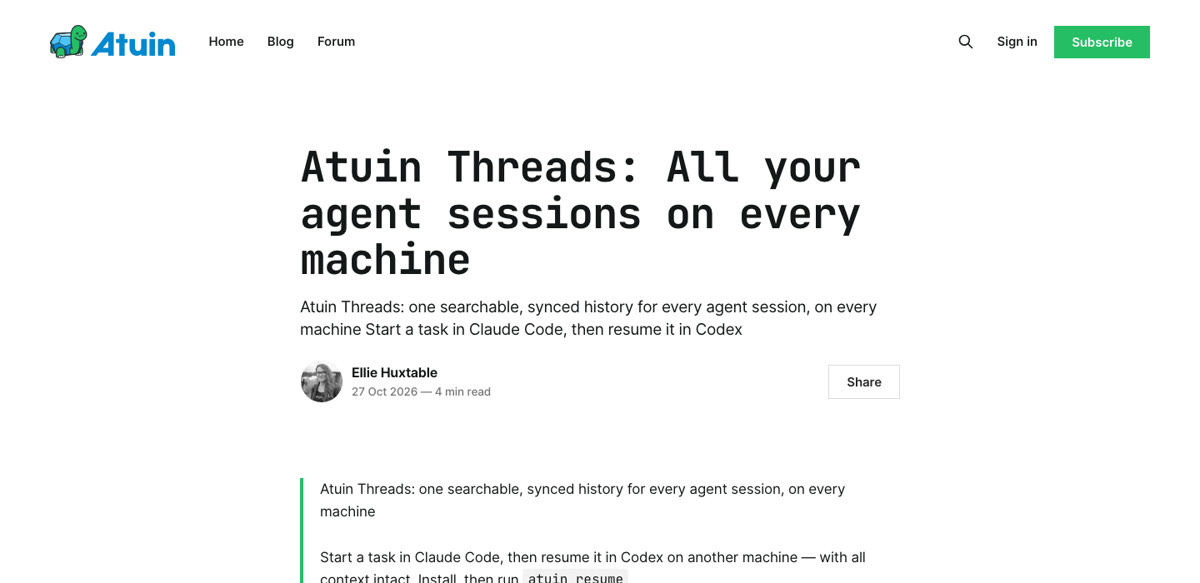
Atuin is Ellie Huxtable’s project, created in October 2020 and MIT licensed. Threads was announced on October 27, 2026 and ships in Atuin 18.24. The releases page shows 18.24.0 through 18.24.4 since, with release notes that mention agent session fixes. Somebody is home.
It reads the session files that Claude Code, Codex, Pi, Omp and OpenCode already write to your home directory and makes them searchable across machines. A task started in Claude Code on a server can be resumed in Codex on a laptop. Sync is end to end encrypted, so the host cannot read it. You can use the hosted server, run your own, or stay local. Capture is opt in. atuin mcp lets agents search the history themselves.
The post’s best example: a Sentry triage agent traced a failed avatar upload to a command run earlier that day, after a rotated storage key lacked a permission. A later agent found that investigation and skipped the rediscovery. That is the post’s account, and I have not seen it happen.
Threads judges nothing. It keeps intent and abandoned attempts and makes them findable. Whether the agent lied about finishing is still your call. It covers your own sessions and none of your customers’ production runs. Team sharing is described as being built.
The catch sits in the thread. A commenter, donald_sh, asked whether sessions can be deleted or excluded from storage. The reply, from an account named ellieh, was: “Not currently, but we will have this very soon!” An agent session holds every command and its output. Until that control exists, I would turn capture on only for work with nothing secret in it.
My verdict: the cheapest answer here, and the first one I would install if I already ran Atuin. It tells you where to look, never that a run went wrong.
Agent Replay
One star, and the best idea in this issue: put what the agent said it changed next to what the workspace shows changed.
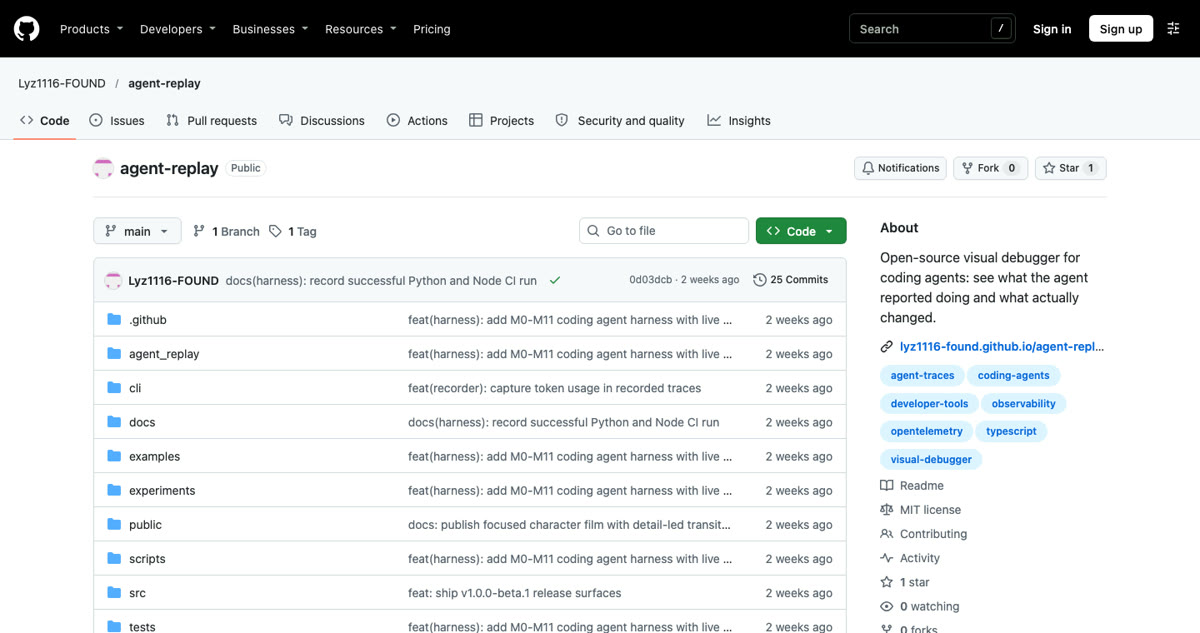
The repository was created on October 20, 2026. It has one star, no forks, an MIT license and a last push on October 23. The maintainer gives no name on GitHub beyond the account handle in the link below. Its issue tracker shows no open issues, and I found no outside discussion.
I searched for another tool that checks an agent’s claims against the workspace and found none with outside users, which is why a one star project is here. It records a coding agent session in a Git repository and builds a timeline of tool calls, test output and code changes. Its capture labels separate what the agent reported from what a workspace diff confirmed, and the viewer shows which reported edits were confirmed and which stay unverified. That is the failure in this issue’s question, the agent that says done when it is not, handled directly.
The README is careful. It reports 130 live runs on one model, 13 variants across 10 Python tasks, one run per cell, and calls them observations that are neither a ranking nor a significance test. Live false completion was zero, because the model fixed every task. The evidence that the check catches anything is a scripted experiment: an agent that does nothing was accepted 10 times out of 10 without verification, and failed the tests 10 times out of 10 afterwards. That shows the check catches a deliberate no op. It shows nothing more. The viewer shows only the activity and reasoning summaries a product exposes; hidden chain of thought stays hidden.
My verdict: a prototype, and I would not run it in production. A second maintainer, or a write up of a real false completion it caught, would change that. Until then, read its README for the reported versus verified split and copy that split into whatever review step you build.
Side by Side
| Laminar | Atuin Threads | Agent Replay | |
|---|---|---|---|
| Who reads the record | A trained model, then you | You or an agent you ask | You, against a diff |
| Where the record lives | Laminar cloud or self hosted | Your machines, synced encrypted | A Git repository |
| Built for | Production agents | Your own coding sessions | One coding session |
| License | Apache 2.0 | MIT | MIT |
| Latest release seen | v0.3.3, November 2 | 18.24.4 | None |
| Cost | From $30 a month by data volume | Free | Free |
How I Would Choose
If you run an agent other people use, take Laminar, and spend the first week checking its flagged failures against traces you read yourself. Its only number that matters is how often it is wrong on your data. If you live in coding agents across more than one machine, install Atuin Threads for work with no secrets in it, and wait for the delete control before anything else. If you are building a review step for agent output, read Agent Replay and mark every claim as reported or verified.
None of them answers nucleus777’s question: telling a bad tool result from an agent that misread a good one. Until someone shows that on traces they did not choose, I would keep a person reading a sample of runs every week.