Stop Paying Opus to Read and Type
I would cut a coding agent’s bill with Headroom first. It shrinks what Opus reads instead of taking work away from Opus, which makes it the lowest risk, and it is the only one of the three whose docs say plainly what nobody has measured. The other two bet that most tokens go to opening files, swallowing tool output and typing routine edits, and not to the decision you hired Opus for. Weave Router 2.0 and Cheap Agent arrived within a month of each other and attack that gap from opposite ends.
How do you cut a coding agent’s bill without giving up the frontier model where it counts? I have not run any of the three. Everything here comes from repositories, docs, launch threads and the authors’ own benchmark tables, which I read as claims.
Cheap Agent
Opus plans, a DeepSeek model reads and types, and a script decides whether the work lands.
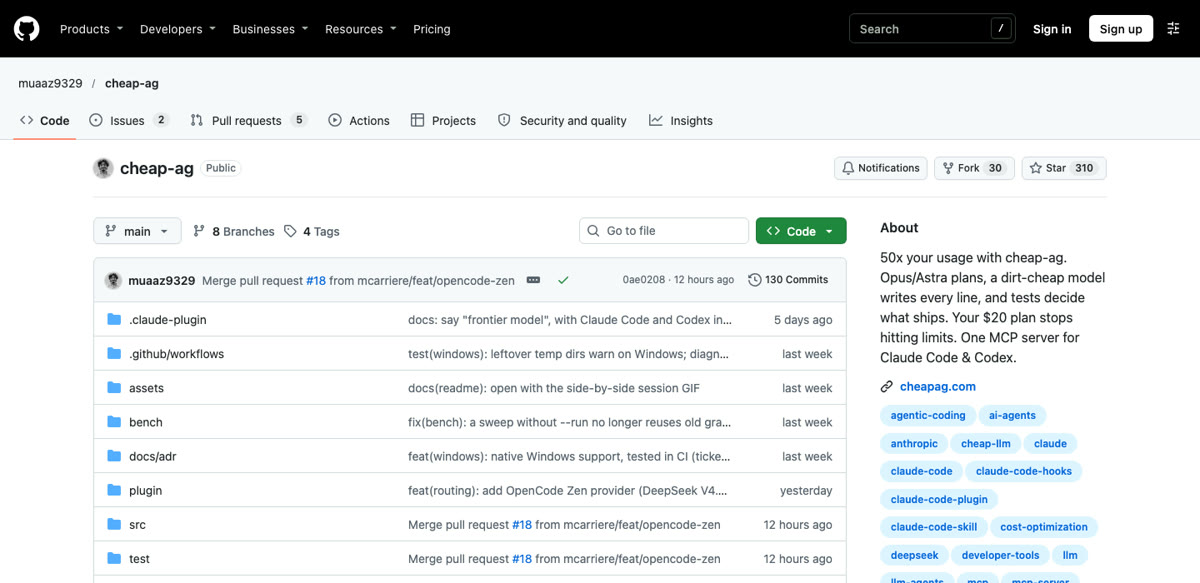
Muaaz Khan wrote it. Their blog post says they are a software engineer in Pakistan who works as a forward deployed engineer, mostly in Go and Node, and that the first commit was on October 15 and the repository went public on October 28. I have not verified any of it. It has 310 stars, 30 forks and an MIT license, and the last push was November 7, the day I looked.
It is an MCP server plus a Claude Code plugin that gives Opus two tools. research sends a cheap model to read the codebase and come back with file and line references. delegate hands it a change to make in a private git worktree copy of your project, with a done when command attached. The worker cannot read .env files and cannot commit. Cheap Agent itself runs the test. No model votes on the result. The check is plain code, and a passing change arrives in your tree uncommitted. Sonnet is the standby if the worker fails a step. Each project needs a one time /cheapag:allow, which is a person agreeing that this repository’s code may go to the cheap provider.
The price has two parts. The plugin is free. The worker runs on your own API key, and the post lists DeepSeek V4.1 Flash at about $0.15 per million input tokens and $0.60 per million output tokens. One feature add cost half a cent by the author’s account.
The numbers come from the author’s own SWE bench Verified runs with Opus 5.5. Across three runs of 24 bugs, the median was 214k Opus tokens per task alone and 87k with Cheap Agent. Seven everyday bugs were solved seven of seven both ways. On the nine hardest bugs it was 3.0M tokens against 1.3M, and the post concedes that Opus alone does a bit better there. Real bugs took about twice as long. That is a saving in Opus tokens, from one person’s small sample. It matters most if a plan limit is what stops you.
The catch is in the README. The worker has to be good at tool calls, and “small models often can’t.” That sentence decides whether your cheap model of choice is allowed near the repository. The test is the only gate. Code with no test behind it walks straight through.
My verdict: pick it if you keep hitting a Claude plan limit and your work has tests you trust. The design is the done when line, and I like that the check costs no tokens. Skip it for the one nasty bug, where the post itself says to let Opus work directly.
Weave Router
A proxy that picks a model for every request your agent makes, from a company that sells engineering analytics.
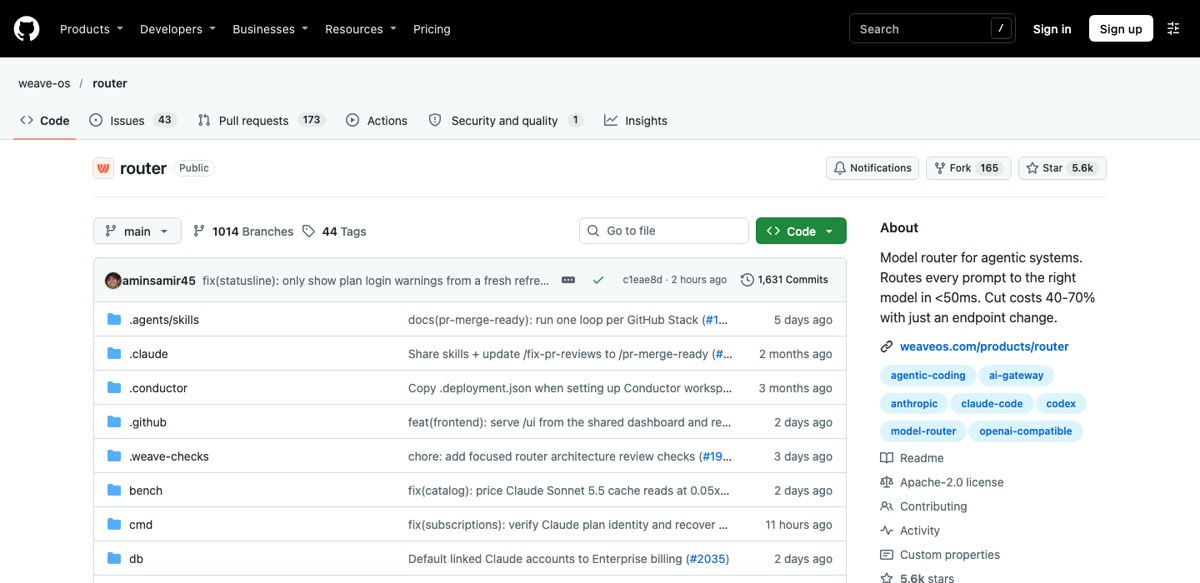
Weave sells engineering visibility, and the first Show HN says the router came from its own team’s rising Opus bills. The company page names its cofounder and CEO by first name only. The Show HN account, adchurch, gives no full name either, so I can say nothing about anyone’s past work. The repository was created on April 27 and has 5,616 stars, 165 forks and an Apache 2.0 license. The first Show HN on June 26 called it source available under the Elastic License 2.0. I read a loosened license plus a 5% hosted fee as a sign that the hosted product is where the money is.
It speaks the Anthropic, OpenAI and Gemini APIs, so you point Claude Code or Codex at it. In the managed version a trained model sends exploring subagents to a model like DeepSeek V4 Flash and keeps planning for a frontier model. The Router 2.0 post of September 30 says it avoids switching models when a cold cache would cost more than the switch saves. The self hosted version is weaker by the README’s own description. It uses a scorer based on a published paper, plus an optional policy model that is “barebones, frozen” and lacks the managed service’s training. The README says the managed router gives the best experience, and the product page prices the managed router at 5% of routed spend.
The benchmark page says more than the launch post did. Its baseline is GPT 6 Astra, a frontier OpenAI model, run in the same Codex harness. On Terminal Bench 4.0, 66 tasks, the router solved 62.1% against 60.6% for Astra, at $5.22 per trial against $10.03. On SWE Atlas, a codebase question set of 124 tasks, it solved 62.1% against 66.1%, five tasks fewer, at $2.31 per trial against $5.04. Scores count a task if either of two attempts passed. The Show HN post called the pass rates equivalent on both and put the SWE Atlas cost at 54% as much. The page’s own figures say 46% as much and a four point drop.
The same page shows OpenRouter’s Auto router on those tasks: 25.0% on Terminal Bench, and 54.0% on SWE Atlas at $1.49 a trial. A router’s price means nothing until its pass rate sits beside it.
The sharpest reply in the first thread is from nikcub, who argued that coding agents already know when they explore, plan or implement, and that a proxy breaks that loop: “It doesn’t know, for ex. that it just attempted with deepseek v4 and it failed, lets try Opus?” The poster, adchurch, answered that agents “are not incentivized to optimize too heavily here.” Fair about agents, and it shows where a router finds its savings. It still dodges nikcub’s actual question, which is what happens after the cheap model fails. Cheap Agent answers with Sonnet as the standby. I found no such step in the router’s docs, and adchurch did not supply one, so I count the hardest comment in that thread as unanswered.
There is an outside check on routing in general, with a different tool. LangChain ran NVIDIA’s open source Switchyard on 145 agent tasks (support dialogue, incident investigation, workflow automation, no coding) and found that only 7% of turns needed Opus 4.8, with 74% lower cost and 93% of its accuracy kept. It also says routing cannot pay when the two models are close in price.
My verdict: pick it only if you pay API prices across a team and can replay a week of your own sessions through it. I did not find an independent run of Router 2.0. Half the cost with four points less on codebase questions is a trade I would want to see in my own repository first.
Headroom
A local proxy that shrinks what the agent reads before the model sees it.
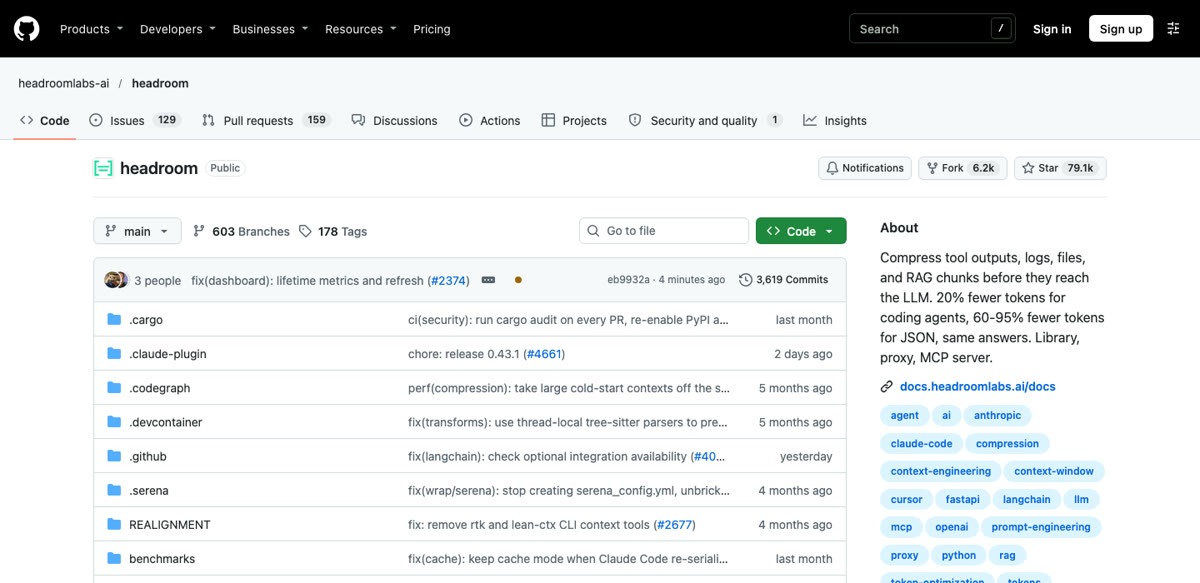
The repository was created on January 7, 2026, is Apache 2.0, and shows about 79,000 stars and 6,180 forks, with a push on November 7. The website lists Foundation Capital Build, Vercel Accelerator and Berkeley Xcelerator. The repository’s owner account is Tejas Chopra’s, the only name I found, and I did not check prior roles.
headroom wrap claude, or a proxy on a local port, puts it between your agent and the provider. It compresses tool output, logs, files and older conversation turns. JSON gets a statistical crusher, source code an AST based one, prose a small trained model. Originals are cached on your machine, and the model has a headroom_retrieve tool to fetch the full text. The README says only new bytes are compressed so the prefix the provider has cached stays identical. The software is free. The team tier has no public price that I could find, only a “talk to us” link, and I count that against it.
The README table has four seeded scenarios built from real MCP output formats: code search 21% fewer tokens, incident debugging 57%, codebase exploration 42%, issue triage 30%. The repository description says “20% fewer tokens for coding agents.” The limitations page is the better document. It says its figures are “not from a published, repeatable benchmark suite.” They are single samples on synthetic payloads. Multi turn agent conversations were not independently measured. The accuracy table, GSM8K and three others at 100 items each, is not about coding. The README also admits that plain prose compresses little and that you may not need it if your provider’s own compaction already covers you.
That candor is why it is the first thing I would install. Its failure case is cheaper too. A cheap model can write a wrong change. Compression can only hide a line the model needed, and the retrieve tool is the hedge. I have not seen that hedge tested on coding sessions. RTK, at about 85,800 stars, does the same for shell command output, but its README says the hook only fires on Bash calls, so the built in Read, Grep and Glob tools bypass it.
My verdict: install it first, run it for a week and compare your provider’s invoice with what its dashboard claims. Until the invoice agrees, I would expect no more than the 20% its own description promises.
Side by Side
| Cheap Agent | Weave Router | Headroom | |
|---|---|---|---|
| Where it cuts | Reading and typing move to a cheap model | Each request goes to the model the router picks | Input shrinks before the model reads it |
| Model quality at risk | Worker output, gated by your tests | Every routed turn | Information dropped from context |
| What you pay | Free plugin plus the worker’s tokens | 5% of routed spend, or self host | Free, team tier has no public price |
| Evidence | Author’s SWE bench Verified runs, Opus tokens | Vendor harness, dollars per trial | Synthetic payloads, tokens |
| Stated loss | About twice as slow | Five tasks fewer on SWE Atlas | Not measured on agent sessions |
How I Would Choose
If a Claude plan limit is what stops you and the project has tests: Cheap Agent, tried on one repository first, with a done when command that fails whenever the change is wrong.
If you pay API prices for a team: Headroom for a week, then a replay of your own sessions through Weave Router, and I adopt the router only if its pass rate stays within two points of the frontier model on my tasks. The page’s own gap on codebase questions was four.
If you work alone on a flat plan and mostly want the bill to stop growing: Headroom, and nothing else until the invoice says otherwise.
The problem none of them solves is comparison. One counts Opus tokens, one counts dollars per trial and one counts input tokens, each on its author’s harness, so I cannot put them in one row. A fair test would run all three on the same tasks and read the invoice. Nobody has published one that I could find.