Your Agent Grades Its Own Homework
I have watched an agent write “all tests pass” under a pull request where the button did nothing. Nobody lied. The agent wrote the code and the tests, ran them, and graded the result, which is a student correcting the exam they set. In the last ten days four tools shipped four different answers, and I would start with RunThru, which films the feature on each pull request for about a dollar.
When a coding agent says its change works, what can check that without taking the agent’s word for it? I have run none of them, so every figure below is a claim from a repository, pricing page or launch thread.
Momentic
A QA agent named Mo that explores your running app like a tester and files each bug with repro steps and a recording.
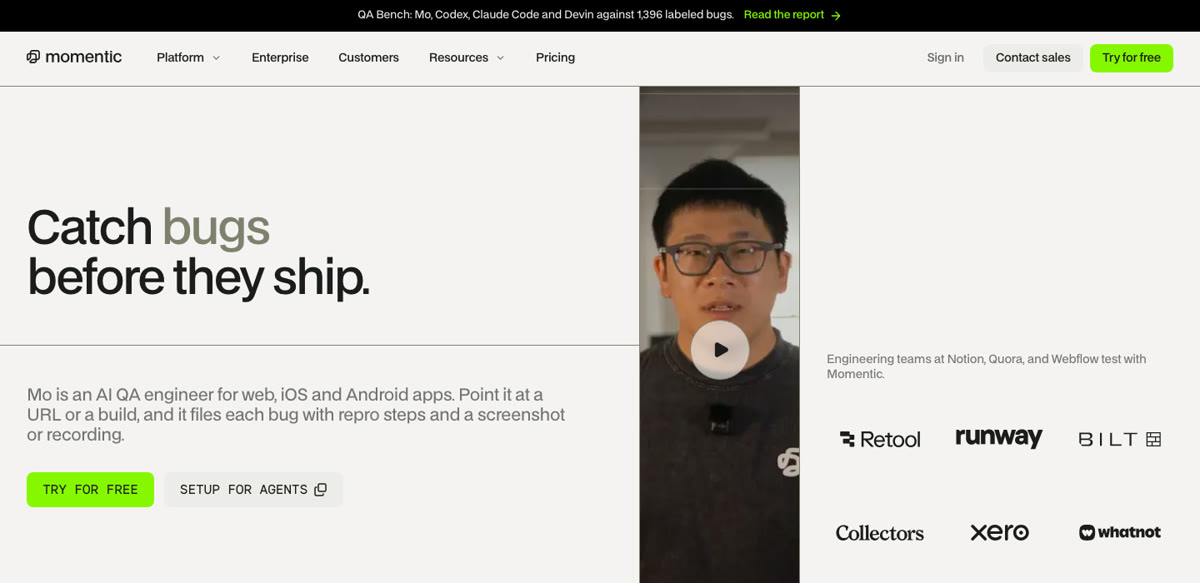
Momentic is Wei Wu and Jeff, a cofounder, YC W24, who say in their Launch HN post that they built dev tooling at Robinhood, Retool, WeWork and Qualtrics before this. The home page lists Notion, Quora and Webflow among its customers. You point Mo at a staging URL or a build for web, iOS or Android, and it forks sub agents that each drive their own browser or device. It writes bug reports.
You buy a balance and spend it down; nobody counts seats. Free is $0 with $50 of usage a month, Scale is $500 a month, and runs pause at $0 instead of billing overages. By the launch post’s own math, each bug Mo matches costs $2.67.
The evidence is QA Bench: 1,396 human labeled bugs in four open source apps (Gitea, Metabase, Twenty, Saleor), 60 minutes per run. Mo matched 269 bugs, a recall of 19.3%, at 84% precision. Codex found 86 at 86% and $0.80 a bug. Claude Code found 59 and Devin 27. So Mo finds three times what Codex finds and charges three times as much for each one.
I like that the write up has a Limitations section that says Momentic built, ran and graded its own benchmark and that the labels came partly from three of the agents being graded. I like less that 19.3% recall means four in five labeled bugs went unfound in an hour. It is still the best result on the chart, and the second best finds about 6%.
The sharpest reply in the thread came from daniiel, who builds in the same space: “a silent pass is worse than a flaky test, since the flaky one at least makes some noise.” That is the failure this whole issue is about: an agent that says done over a broken button is a silent pass with good manners. The Momentic engineer who answered conceded it, saying QA Bench is “not a great fit for measuring pass/fail currently,” because every fixture is full of bugs and almost every run finds at least one, so the fail rate comes out near zero. A pull request variant is in progress. So Mo is very good at finding bugs, and the one number you would gate a merge on does not exist yet.
My verdict: a good bug bash for a team with a staging site and a budget, and the one of the four I would point at a whole product before a release. I would not let it sign off a single pull request until that variant ships.
RunThru
Comment a command on a pull request and a film of the feature working, or failing, appears in the thread.
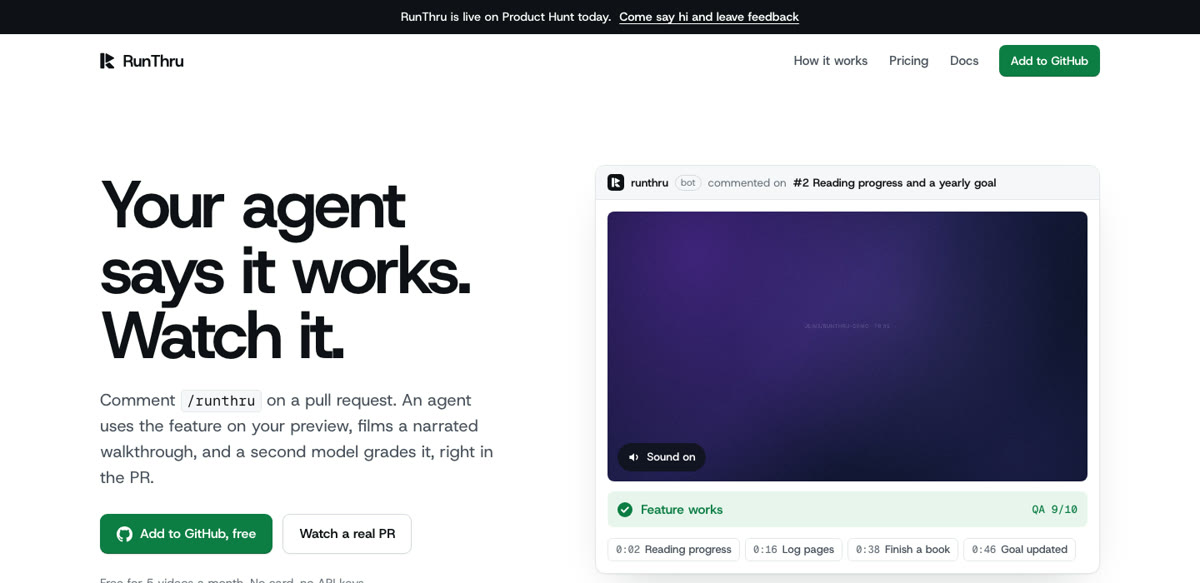
I could not find who built it, nor any public reply from a user. The site names no founders and its Product Hunt page returned a 403 for me, so treat the company as unknown. What the site does say is concrete. Someone with write access comments /runthru on a pull request. An agent opens the preview deployment in a real browser, uses the feature the diff touched, and films a narrated walkthrough. A second model watches the cut and posts a verdict. About five to eight minutes later it is all in the thread.
The detail I would have picked even without the price: Claude Opus 5.5 explores and writes the script, and Gemini 3.1 Pro reviews. The agent that films the video never grades it, and the grader comes from another vendor. It reads only a curated diff and screenshots, never pushes code and never runs your repository’s code.
Free is 5 videos a month. Pro is $29 a month for 30 videos, then $1 each, and Team is $99 for 100, then $0.90 each. The site also says anyone can watch for free. Per video is a brave unit for a product whose customers are agents that open pull requests by the hundred. The best week your agent ever has is also your biggest RunThru bill.
The catch is that its showcase is its own. On a staging site it flagged comments dated “62d ago” under a trial page that had just landed, which is a lovely catch and a sample of one. Its demo verdict reads “QA 9/10”, a grade from a model that nobody has benchmarked. It needs a preview deployment that a browser can reach, and it films the flow the change touched, so a bug three pages away is not its business.
My verdict: this is the one I would turn on first for a web team whose agents open pull requests faster than humans read them. The film is the point, because a person can check a minute of video faster than a diff. I would require its check only after counting a month of its misses.
Sandbox MCP
A real, disposable Windows 11 machine your agent can drive, photograph and throw away.
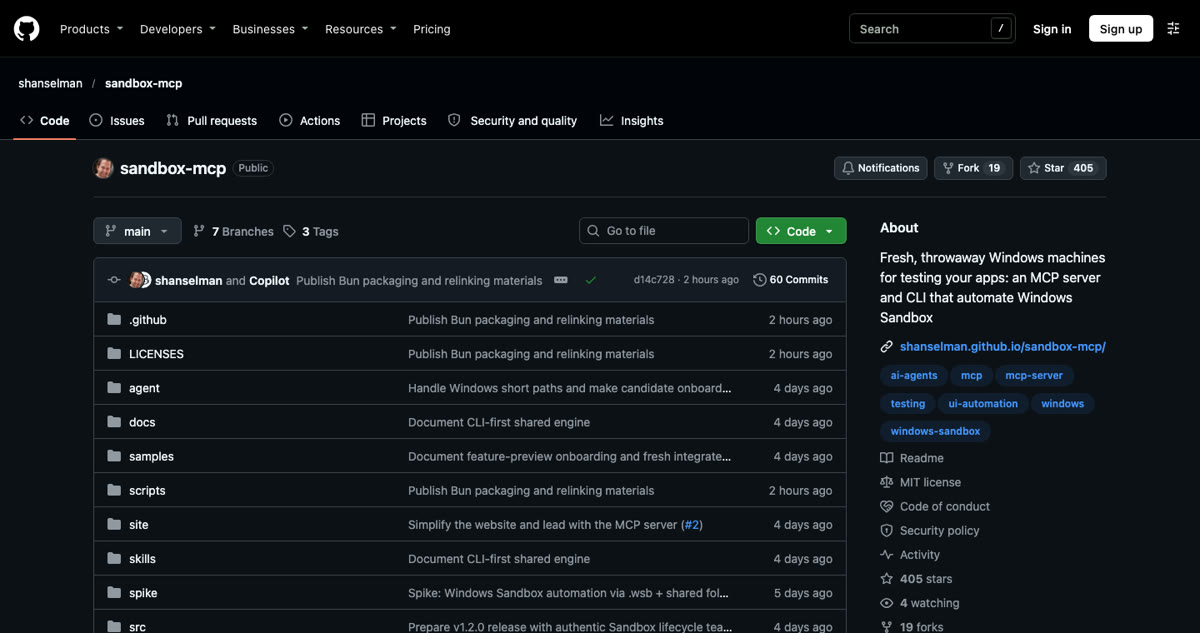
It is published from Scott Hanselman’s GitHub account, whose profile lists Microsoft. The README itself claims no affiliation, and I am not assuming one. It has 405 stars, 19 forks and an MIT license, was created on November 6 and reached version 1.2.0 the next day. The last push was the morning I looked.
The idea is plain. The sbx command, or the optional MCP server, boots Windows Sandbox, deploys your app into a fresh guest, drives its controls through UI Automation (WinForms, WPF, Win32, WinUI), and keeps screenshots, a markdown report, crash events and an audit log on the host after the machine is deleted. The README’s measured GUI samples take roughly 40 to 50 seconds. Network can be off entirely.
Its best example answers my question better than any score. A build the agent called fine failed on a clean guest in 29.8 seconds because the Visual C++ runtime was missing, the classic works on my machine. When the tool installs the runtime on request, the report is stamped PROVISIONED and says outright that this is not a clean machine pass, like a waiter announcing the soup is reheated. A tool that labels its own weaker pass is rare, and I trust it more for that.
The cost is free, but the reach is narrow. Windows Sandbox needs Pro, Enterprise or Education, never Home or Server, and the packages are x64 only. It checks that the app starts and behaves on a blank Windows machine. It does not check that the feature is right.
My verdict: if you ship a Windows desktop app and let an agent build it, run this today. If you ship a website, ignore it, and no amount of stars changes that.
Replica
An agent skill that rebuilds a UI from a reference and then fails the build until a score passes.
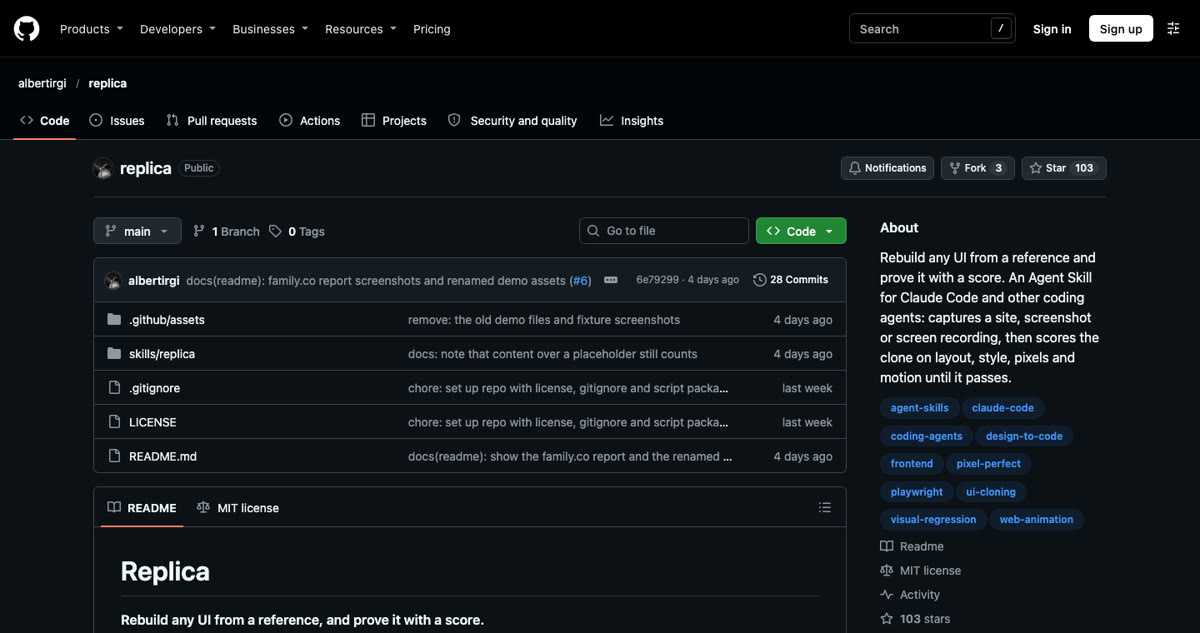
The repository belongs to a GitHub user called albertirgi whose profile says software engineer, and I know nothing else about them. It has 103 stars, 3 forks and an MIT license, created November 2. It needs no API keys.
Replica captures a live page, screenshot or screen recording into a blueprint of design tokens, element boxes and motion curves. After the agent builds from it, compare scores layout, style, pixels and motion. It exits with a non zero code until the gates for the chosen level pass. At the default faithful level that means layout 95, style 95, pixels 85 and motion 90. Each round lists fixes ranked by points gained, and the agent stops when the score passes or after 8 rounds with an account of what is left. Its demo is a hero section that looked done but whose words rose flat. Round one scored 77.8 and named the missing tilt.
Done is a number the agent cannot talk around, and I wish more tools worked that way. The skill file even forbids the obvious cheats, such as embedding screenshots of the reference or lowering the level to get a pass. Those rules live in a prompt, and an agent hungry for a green score can ignore a prompt. A comparison needs a reference, though, so it answers the narrow question of whether a clone matches, never whether a feature does its job. The README lists its own limits: web UI only, video elements frozen on their first frame, and the reference’s fonts and assets belong to their owners.
My verdict: use it if your agent rebuilds designs or marketing pages from a reference, where “close enough” has been an argument for years. It will not tell you your checkout works.
What I Would Wire Up Monday
Match the check to what the agent hands you. A web pull request gets RunThru, because a filmed minute beats a diff. A Windows build gets Sandbox MCP. A page cloned from a reference gets Replica. A whole product before a release gets Momentic, with a person reading the bug list.
None of them answers the one question I care about. Ask each one how often it says pass on a change that is already broken. Momentic’s own engineer says its benchmark cannot answer that, RunThru’s 9 out of 10 has no benchmark behind it, and the other two only cover what they can measure. Until someone publishes that rate, a green mark from any of them is another agent grading, with better evidence attached. Keep the human click on merge, and use these to make that click take one minute.